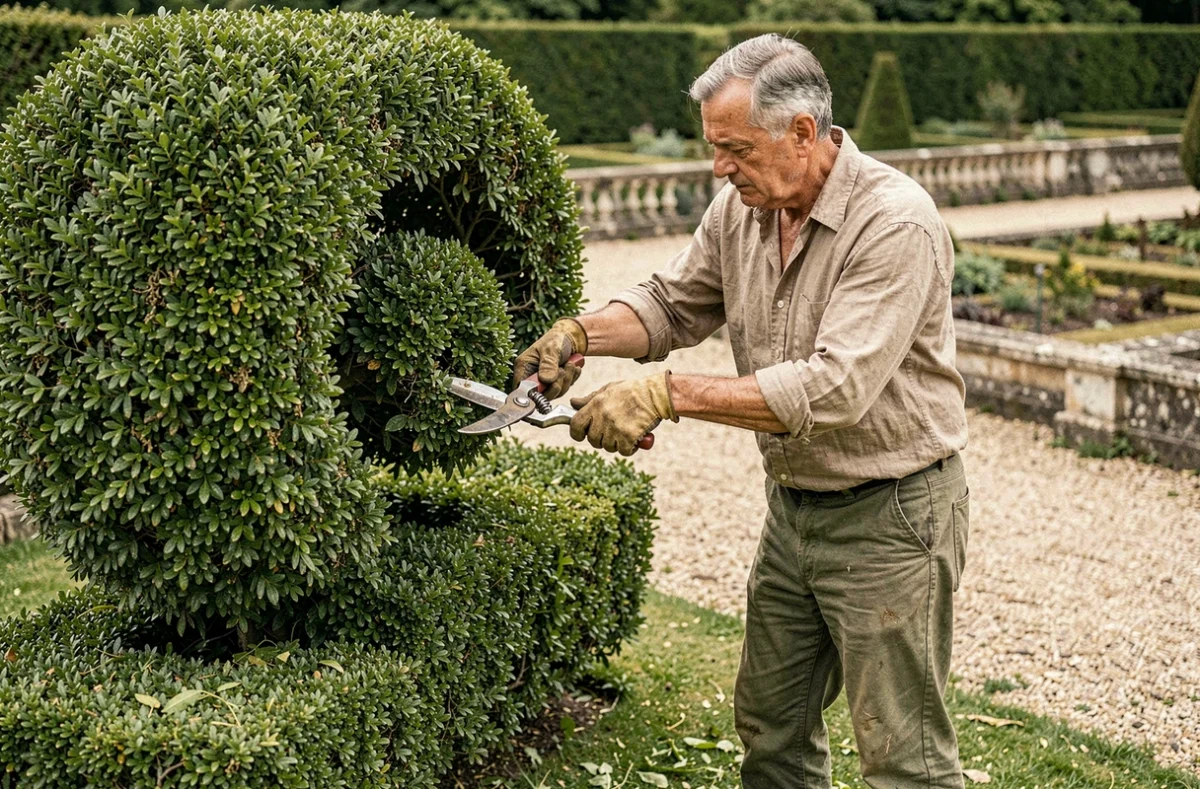
A boxwood planted for ten years that overhangs the path, a yew that has become shapeless after two seasons without intervention: it’s often this kind of concrete situation that leads one to take an interest in hedge sculpting. Pruning is no longer enough; we want to give a shape, a volume, sometimes a real pattern to our plants. Topiary art, long reserved for castle gardens, is now practiced in modest spaces, provided one chooses the right techniques and the right time.
Inspection before pruning: the legal constraint that no one should ignore
Before putting any blade to a hedge, one must inspect. The recommendation comes directly from the French Office for Biodiversity and the LPO: nests, eggs, and protected species remain protected all year round. Pruning must be interrupted if it risks destroying an occupied nest, even outside the classic nesting period.
There is no single national period that automatically prohibits individuals from pruning a hedge. Recommendations suggest avoiding heavy interventions from spring to the end of summer, but the regulatory reality varies from one area to another.
Prefectural or municipal orders may regulate intervention periods and noise disturbances. Before sculpting, one should check the rules of their department or municipality rather than relying on a generic calendar found online. The unique regime governing the destruction of hedges, which came into effect in 2026, mainly concerns uprooting and destruction, not common topiary pruning, but confusion between the two remains frequent.
The operational reflex takes five minutes: walk around the hedge, observe the branches at eye level and lower down, and look for signs of active nesting. If a nest is spotted, postpone the intervention in the affected area. Several resources help better understand the gestures and tools suitable for hedge sculpting, such as sculpte-haie.com, which details the different technical approaches.
Species suitable for topiary sculpting: choosing the right plant
You do not sculpt a cherry laurel like a boxwood. The choice of species determines the complexity of the shapes that can be achieved. Some plants can withstand repeated pruning and produce dense foliage that retains its shape, while others become sparse or heal poorly.
Evergreen plants for geometric shapes
- Boxwood (Buxus sempervirens) remains the reference for balls, cones, and spirals due to its slow growth and fine foliage that tolerates close cuts.
- The yew (Taxus baccata) accepts severe pruning and even regrows on old wood, allowing for corrections of a failed shape over several seasons.
- Privet (Ligustrum) grows faster and requires more frequent passes, but it forgives mistakes thanks to its vigor.
- Holly (Ilex) offers shiny foliage that lends itself to rounded shapes, with the added advantage of deterring intrusions.
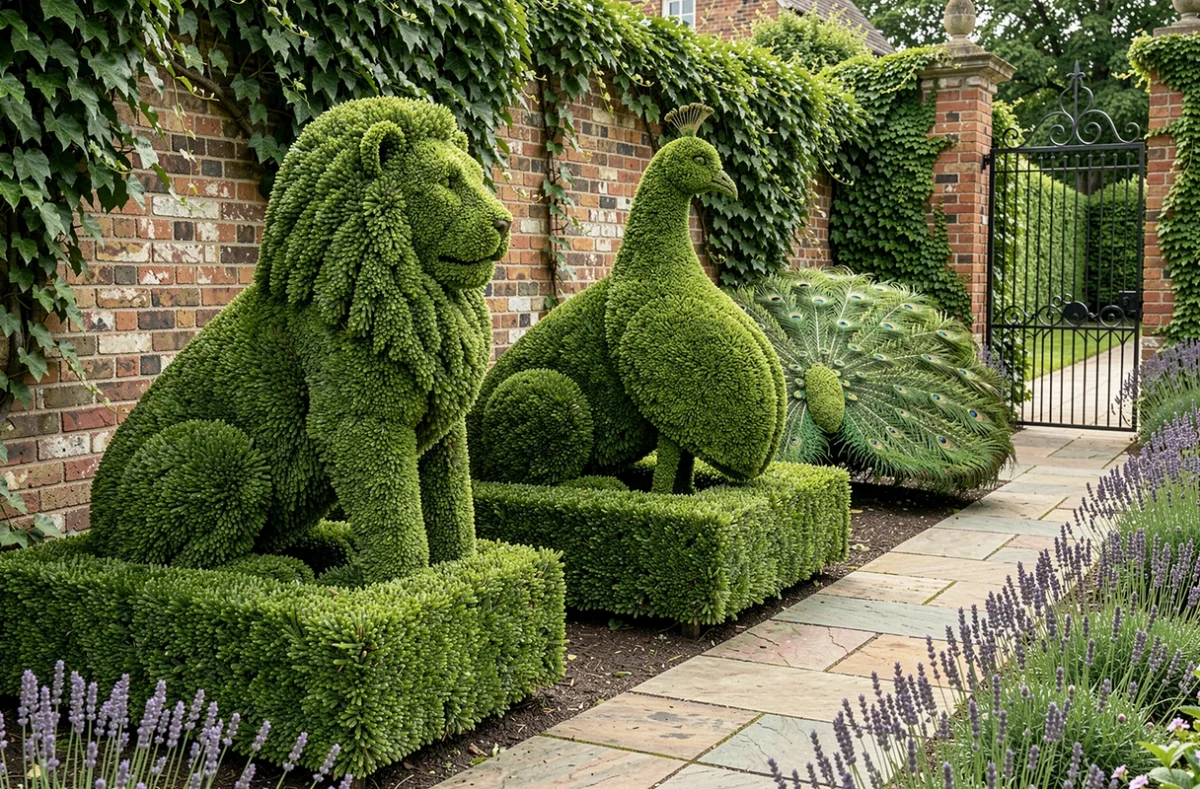
For complex shapes (animals, tight spirals), species with small leaves and slow growth are preferred. A Photinia or an Eleagnus will suit wide undulations, but not fine sculpted detail.
Hedge sculpting technique: from template to finishing gesture
Topiary sculpting relies on a methodical progression. One does not start with shears in hand without a plan.
Making or placing a template
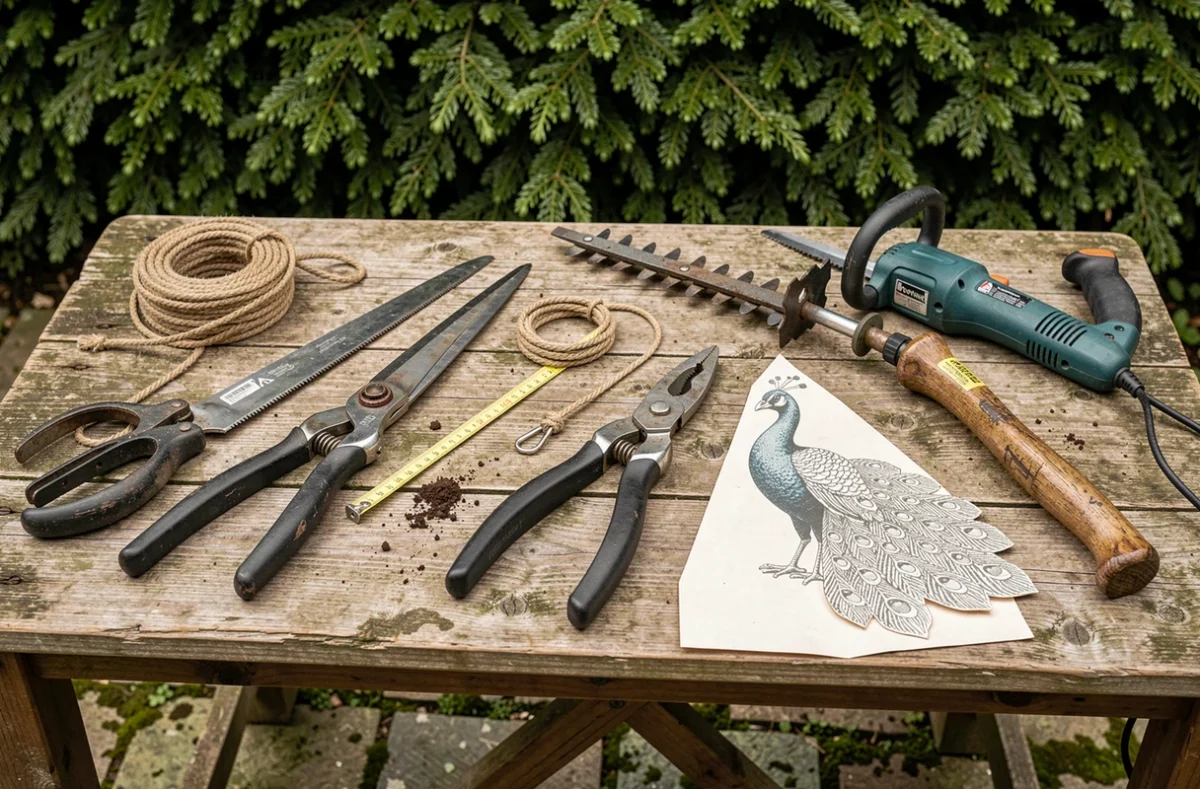
A rigid wire template fixed directly onto the plant guides the cut and avoids asymmetries. It is shaped to the desired form (cone, ball, spiral), secured with stakes, and then everything that exceeds is pruned. For a simple geometric shape, a wooden frame or a metal hoop is sufficient.
Feedback varies on the time required for shaping: expect at least two to three seasons to achieve a dense and regular volume on a medium-sized boxwood. Forcing the shape in a single severe cut risks hollowing out the interior of the plant.
Tools and cutting gesture
The hedge sculptor (short motorized shears) differs from a standard hedge trimmer by its smaller blade and maneuverability. It is used for finishing touches and tight curves. For the heavy work (volume reduction, rough shaping), a standard hedge trimmer is suitable.
The cut is always made from bottom to top so that debris falls without obscuring the cutting line. On a conical shape, the blade is slightly angled so that the base remains wider than the top, ensuring uniform sunlight exposure throughout the height.
Maintenance of a sculpted hedge: frequency and common mistakes
A topiary hedge requires more passes than a free-form hedge. On a boxwood or yew, two to three prunings per year maintain a sharp outline. On a vigorous privet, an additional pass is needed during the peak growing season.
The most common mistake is pruning too late in the autumn. A late cut stimulates young shoots vulnerable to frost. Interventions should cease well before the first frosts to allow the wood to harden.
Another pitfall: neglecting the interior of the hedge. If only the outer surface is pruned for years, the center becomes sparse. A light thinning of the interior, by removing a few dead or crossed branches, allows light to penetrate and the foliage to renew deeply.
On the nutrition side, adding compost at the base in late winter supports regrowth without causing excessive growth. Rapid-release nitrogen fertilizers produce soft shoots that are difficult to maintain in shape.
Hedge sculpting combines patience, observation, and regularity. The result is not judged after the first cut but after several cycles of growth and pruning, when the plant has integrated the shape into its very structure. It is a foundational work, rooted in the rhythm of the seasons, that rewards those who take the time to inspect before cutting and allow the plant to respond before making corrections.