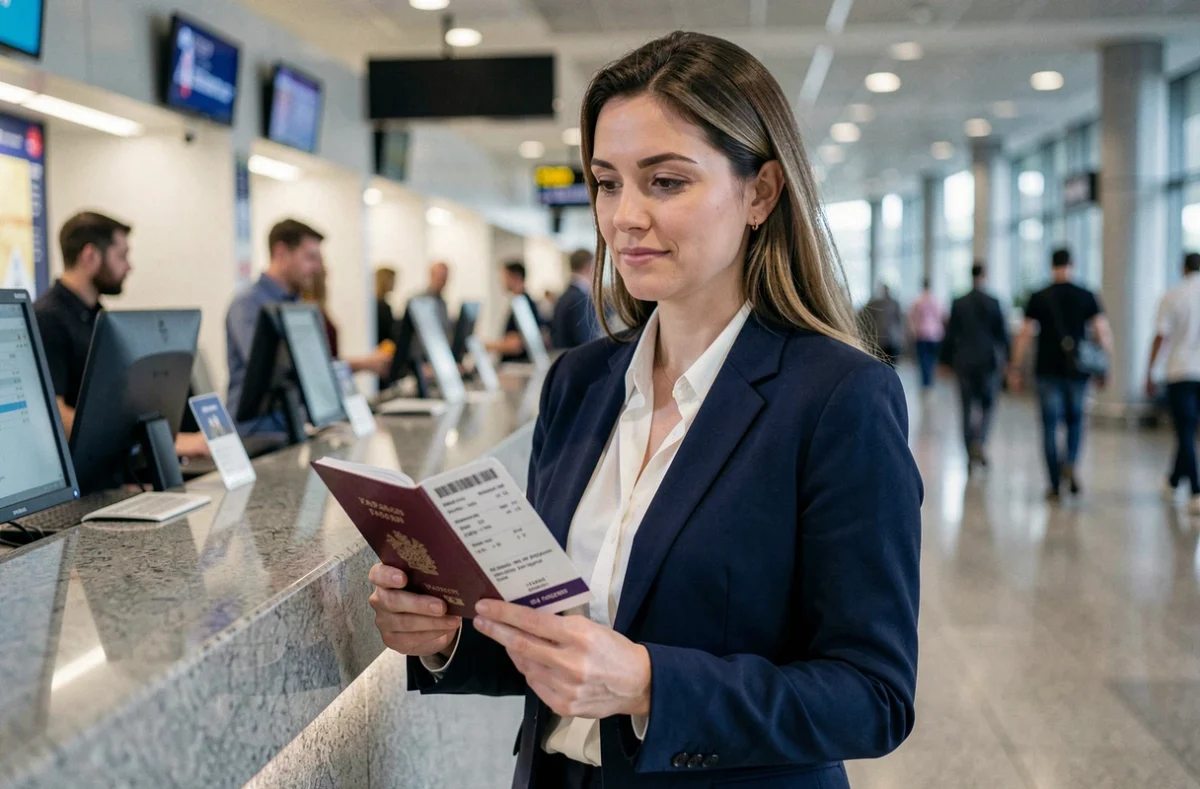
A married name is a name in use, not a replacement for a surname. On a French passport, the birth name remains the legal name. The passport’s machine-readable zone (MRZ) encodes only the birth name, even if the name in use appears on the civil status page. Any discrepancy between the MRZ and the name entered in an airline booking can lead to a block at automated checks.
Passport MRZ and booking systems: the technical sticking point
Automated gates and airport scanners read the MRZ, not the passport’s visual zone. The “surname” field in this machine-readable strip contains the birth name. The name in use, whether a married name or a spouse’s name, is not encoded there.
Airlines work in the same way. The APIS (Advance Passenger Information System) form sent to the authorities in the destination country relies on MRZ data. A booking under “DUPONT” when the MRZ shows “MARTIN” will cause an automated matching failure.
The rule is straightforward: the name entered in the booking must match the MRZ of the passport presented at boarding, letter for letter. An agent at the counter may sometimes resolve a minor discrepancy. Self-service kiosks and e-gates, however, have no room for interpretation.
Travelers whose passport shows a married name in the visual zone should bear this in mind: the “wife of Y” notation on the document does not change what the machine reads in the MRZ.
Multi-airline itineraries and stopovers: when using a married name creates a risk of disruption

On a direct flight operated by a single carrier, the risk is limited. Things become more complicated as soon as an itinerary involves multiple airlines or a stopover in a third country.
Each carrier manages its own PNR (Passenger Name Record). When a booking is made through a GDS (Amadeus, Sabre, Travelport), the name is passed on to each segment. If the original booking uses the name in use and one segment is operated by an airline that strictly requires a match with the MRZ, the passenger may be stopped at the layover, not at the point of departure.
A stopover in a country requiring a visa or electronic authorization increases the risk. Transit authorities cross-check APIS data against their immigration database. A name in use that the local system does not recognize may trigger a refusal of transit, even if the airline operating the final flight accepts the passenger.
We recommend checking the entry and transit requirements for every leg of the itinerary using the exact document that will be presented. France Diplomatie’s “Travel Advice” section details requirements country by country.
Booking through a travel agency and correcting a name
When a ticket has been issued through a travel agency, the name correction must first be made through the GDS: the agency has to submit the request. The conditions depend on the carrier and the booking channel.
- Some airlines allow minor name changes (such as correcting a typo or adding the birth name) free of charge within the first few hours after ticket issuance
- Others charge for the change at the same rate as a passenger name change, sometimes several dozen euros per segment
- For a multi-airline ticket, each carrier must approve the correction for its segment, which can extend processing times
Request written confirmation of the correction before departure. A simple email acknowledgment from the agency does not prove that the change has been propagated to every segment.
Birth name and name in use on a French passport: what the law says
The law of 6 Fructidor, Year II, establishes the principle that the birth name is the only legal name. A name in use (a spouse’s name or a double-barrelled name) is optional, not an automatic right recorded in the civil registry.
ICAO (International Civil Aviation Organization) recommends that the surname be included as mandatory data on passports. A name in use remains optional. France follows this recommendation: a French passport shows the birth name under “surname” and the name in use in a separate field.
This document structure explains how the MRZ works: it encodes the mandatory data, namely the birth name.
National ID card and passport: same logic, same pitfall
The national identity card follows the same structure. The birth name appears in the MRZ, while the name in use appears in the visual zone. For travel within Europe, where a national ID card is sufficient, the risk of a mismatch with the ticket is the same.
Booking a flight under your birth name: the reliable approach
The safest approach is to always book under the name shown in the MRZ of the travel document you will use. For almost all French passports, this is the birth name.
- Open the passport to the MRZ page (the two lines of characters at the bottom of the identity page) and copy the name exactly as it appears there
- Do not add “wife of,” “née” or “widow of” in the booking’s name field, even if the form allows it
- Check that every segment of a multi-airline itinerary shows the same name on the confirmation
- If in doubt, contact the airline before the ticket is issued to confirm the required format
This approach eliminates almost all name-related boarding issues. It also applies to hotel or car rental bookings in countries where ID documents are checked at the counter.
A ticket already issued under a name in use is not a dead end, but the correction must be handled before departure, ideally several days in advance. Relying on a fix at the check-in counter on the day of the flight is still a risky bet, especially on international flights subject to APIS checks.
The machine reads the MRZ, not the visual page. Matching the ticket name to the passport MRZ solves the problem at its source.