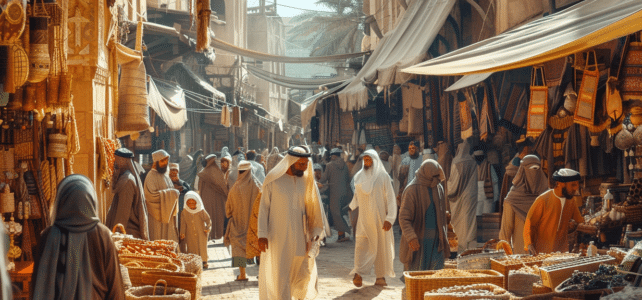
Popular expressions from the Arab world, rich in history and culture, offer a fascinating insight into daily life and values in this region. Each saying or proverb, often tinged with humor or ancestral wisdom, reflects a shared experience across generations. For example, ‘El sabr miftah el faraj’ (Patience is the key to relief) illustrates the importance of perseverance in the face of trials.
These expressions, passed down orally over the centuries, play a fundamental role in communication and social cohesion. They reveal cultural nuances and unique perspectives while strengthening the bonds between individuals.
Popular expressions from the Arab world and their cultural context
The Arabic language, spoken by over 300 million native speakers, is the liturgical language of Islam. Arabic is not limited to everyday communication; it serves as a bridge between cultures and generations.
Expressions and meanings
- Wallah: to attest to one’s good faith
- Salam: to greet someone
- Hagra: to make someone suffer
- Khabat: to consume illicit substances
- Khouya: brother
- Seum: when one is fed up
Take, for example, the expression ‘Wallah Lahdim’. Used to guarantee the truth of a statement, it conveys a deep commitment to truth.
Proverbs and values
Arabic proverbs, such as ‘Al-Sabr Miftah Al-Faraj’ (Patience is the key to relief), illustrate universal values. They serve an educational role, imparting life lessons through concise and impactful formulations.
Similarly, expressions like ‘Al-Hubb Min Allah’ (Love comes from God) emphasize the importance of spirituality and human relationships in Arab culture.
Common usages
Expressions like ‘As-Salamu ‘Alaikum’ (Peace be upon you) and ‘Shukran’ (Thank you) are ubiquitous in daily interactions. They reflect a courtesy and respect deeply rooted in Arab society.
The linguistic diversity and richness of popular expressions reveal a culture deeply rooted in history and spirituality. Understanding these expressions is to penetrate the soul of a people and appreciate their worldview.
Meanings and usages of popular Arabic expressions
Popular Arabic expressions reflect a rich and diverse culture. They convey values, emotions, and teachings often rooted in tradition and spirituality. Here are some of the most common expressions and their meanings:
- Wallah: to attest to one’s good faith. This expression is used to confirm the truth of one’s statements.
- Salam: to greet someone. A simple yet powerful word symbolizing peace.
- Hagra: to make someone suffer. An expression that conveys oppressive behavior.
- Khouya: brother. An affectionate term used to refer to a close friend or brother.
- Seum: when one is fed up. Commonly used to express deep frustration.
Proverbs and popular wisdom
Arabic proverbs, like ‘Al-Sabr Miftah Al-Faraj‘ (Patience is the key to relief), are life lessons passed down from generation to generation. These aphorisms play an educational role by highlighting essential values.
Interactions and courtesy
In daily interactions, expressions like ‘As-Salamu ‘Alaikum‘ (Peace be upon you) and ‘Shukran‘ (Thank you) are omnipresent. They embody a courtesy inherent in Arab culture.
Love and relationships
Expressions such as ‘Ya Habibi‘ (My dear or My love) and ‘Ana Uhibbuka‘ (I love you) reveal the importance of emotional relationships. They testify to the depth of feelings expressed in the Arabic language.
These popular expressions show how deeply the Arabic language is rooted in social interactions and cultural values. Understanding these words and their usages is to grasp an essential fragment of the identity and richness of the Arab world.