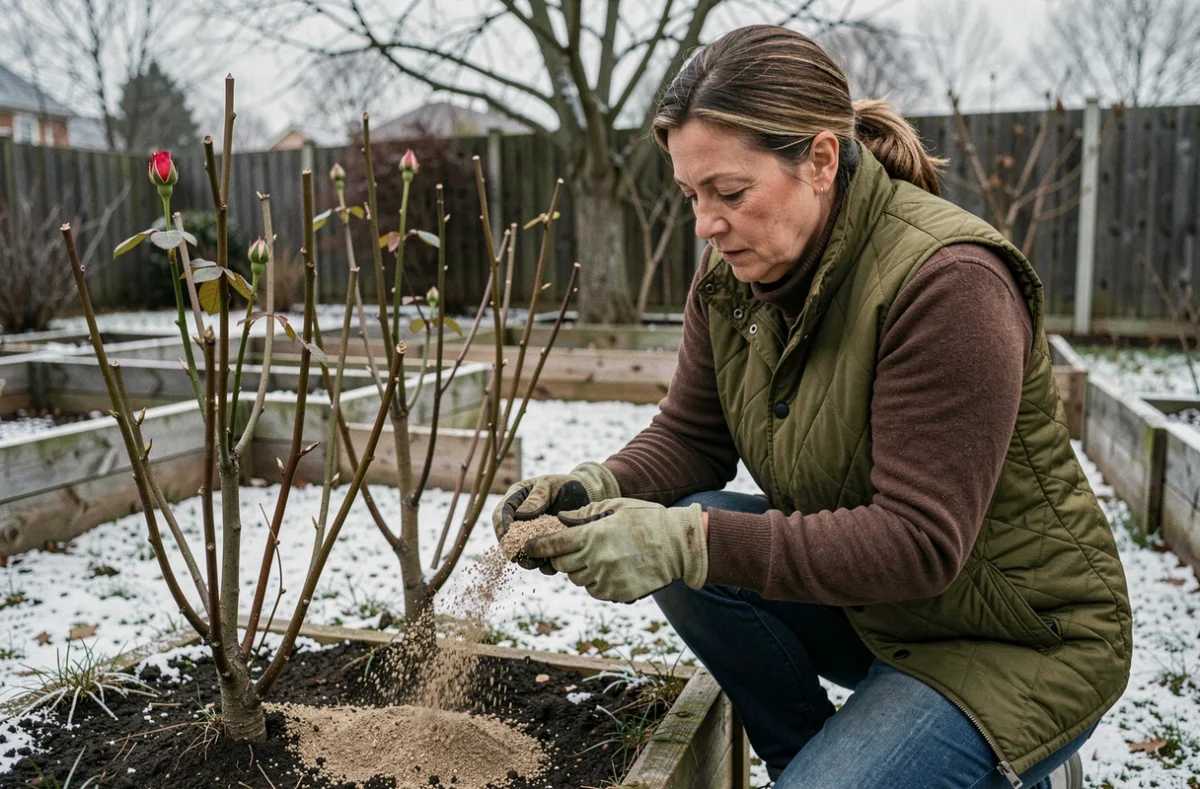
A rose bush that comes back black in spring, a fruit tree whose young shoots freeze as early as March: often, the problem does not stem from the cold itself, but from poorly calibrated fertilization in the fall. Choosing the right fertilizer for winter starts with understanding what the plant needs when it slows down, not when it is growing.
Biostimulants and traditional fertilizers: two distinct approaches for winter
People often confuse NPK fertilizers with winter protection products. A traditional fertilizer provides nutrients (nitrogen, phosphorus, potassium) to fuel growth. A biostimulant, formulated from extracts of algae such as Ascophyllum nodosum, amino acids, or humic and fulvic acids, works differently: it activates the plant’s defense mechanisms against the cold.
These two categories do not replace each other. In practice, the biostimulant is applied at the end of summer or early autumn, before winter stress sets in. The fertilizer, on the other hand, is dosed differently depending on the season. Mixing the two indiscriminately is like feeding a plant that is not hungry while forgetting to strengthen its defenses.
To delve deeper into these seasonal formulation choices, you can consult the winter resources on Envies de Jardin that detail several suitable combinations.
Nitrogen-potassium ratio: the adjustment that changes everything before frost
When preparing your plants for winter, the first reflex should be to read the NPK label of the fertilizer. Not to check the overall dosage, but to control the ratio between nitrogen (N) and potassium (K).
Too much nitrogen at the end of the season stimulates tender shoots, filled with water, that do not withstand the first serious frost. This is the classic trap for gardeners who continue their summer fertilizer until October. These young plant tissues do not have time to lignify and become the first victims of the cold.
Potassium plays the opposite role. It strengthens the water regulation of the cells and improves resistance to thermal stress. Syntheses based on several dozen studies show that potassium supply under stress conditions increases biomass and photosynthesis while reducing markers of oxidative damage. In short, a formula rich in potassium and low in nitrogen prepares the plant to withstand the cold.
On the ground, we look for a fertilizer whose last number in the NPK ratio is significantly higher than the first. For example, a 3-5-8 fertilizer is better suited than a 10-10-10 for autumn application. Phosphorus, in the middle, supports root health during dormancy.
Organic or mineral fertilizers for winter: concrete selection criteria
The question cannot be answered in one sentence, because the context of each garden matters. A heavy clay soil does not react like a draining sandy substrate.
Slow-release organic fertilizers
Ground horn, bone meal, or guano release their nutrients gradually through microbial decomposition. In winter, this decomposition slows down with the soil temperature, which naturally limits the risk of overdosing. This is a clear advantage when you do not want to monitor your inputs every week.
- Ground horn provides very slow-release nitrogen, ideal for a nutrient base without stimulating fragile growth
- Bone meal provides phosphorus that strengthens the root system during dormancy
- Mature compost, spread in a thin layer, acts both as an amendment and as a protective mulch for the soil
Responses vary depending on the type of soil: on a limestone terrain, bone meal decomposes more slowly, and the effect may take several months to manifest.
Mineral fertilizers: when precision is key
For potted plants or crops under cover, a liquid mineral fertilizer allows for finer dosing. The frequency is reduced to once a month at most, and the usual dose is halved or even reduced to a third. In pots, the substrate does not buffer excesses like soil in open ground, and winter overdosing burns inactive roots.

Mulching and green manures: direct complements to winter fertilization
A fertilizer alone does not protect the soil. Without cover, winter rains leach away some of the nutrients supplied, which end up in the groundwater rather than in the roots.
Organic mulching (dead leaves, wood chips, straw) serves two simultaneous functions: it thermally insulates the soil and nourishes microbial life as it decomposes. A mulch of a few centimeters limits the leaching of fertilizers and maintains a more stable soil temperature, which promotes residual root activity.
For the vegetable garden, green manures sown in autumn (rye, vetch, mustard) capture atmospheric nitrogen and structure the soil during winter. They are buried in spring, a few weeks before planting, to return organic matter. This technique effectively replaces a chemical nitrogen fertilizer input at the end of winter.
- Rye withstands the cold well and produces dense root biomass that loosens heavy soils
- Vetch fixes atmospheric nitrogen and enriches the soil naturally
- Mustard grows quickly and smothers autumn weeds before freezing
Application calendar: the right action at the right time
It is often a mistake to fertilize too late. The main application occurs between September and mid-November, when the soil is still warm enough for microorganisms to work and for roots to absorb. After December, most inputs remain on the surface without real benefit.
For indoor plants, the logic differs. Our heated apartments maintain a temperature that prevents complete dormancy. A very diluted input, once a month, is enough to support minimal activity without forcing growth. Normal fertilization resumes in March, when light levels increase.
The choice of a winter fertilizer is nothing spectacular: it is an adjustment of the NPK ratio, a shift to a potassium-dominant formula, and a soil cover that does the rest. The plants that come back strong in spring are those that were prepared without excess four months earlier.