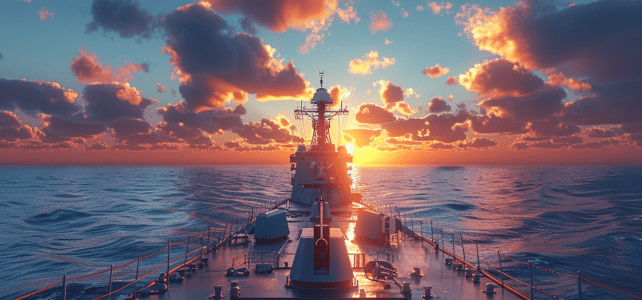
The military shipbuilding industry is at the forefront of innovation, driven by an incessant quest for superiority at sea. This realm, where security and performance are paramount, benefits from major technological advancements, such as the integration of artificial intelligence systems, the development of autonomous vessels, and the enhancement of stealth and weapon systems. The stakes are colossal: each advancement paves the way for new defense and deterrence strategies. The prospects for innovation in this field continually redefine the operational capabilities of fleets while raising strategic, ethical, and economic questions.
Evolution of Technologies in the Military Shipbuilding Industry and Impact on Defense Capabilities
The future French warship, a feat by Naval Group, symbolizes the dynamism of the national military shipbuilding industry. The construction of the Frégate de défense et d’intervention (FDI), equipped with cutting-edge technologies, illustrates France’s adaptation to the rapid changes characterizing the naval sector. The impact on defense capabilities is considerable, providing the French Navy with a formidable and versatile naval combat tool capable of playing a key role within NATO.
Related reading : Trends and News to Follow in the Real Estate Sector in 2024
The integration of artificial intelligence and the deployment of military drones reflect a naval innovation aimed at the new generation. These technological advancements, combined with the digital revolution, grant warships increased decision-making autonomy and unprecedented operational efficiency. Naval Group, in partnership with MBDA, integrates these innovations into the FDI, thereby strengthening France’s role in the naval sector and national defense.
The French naval industry, faced with the acceleration of technological cycles, plans to recruit 30,000 people in the next decade to support this growth and maintain the sector’s competitiveness. This support from the state and industry is essential to ensure the transition to these new capabilities and prepare France to meet future challenges, both nationally and internationally.
Further reading : Practical guide: how to use the Wannonce member area and log in easily
Innovation Prospects and Challenges for the Future of the Military Navy
Decarbonization emerges as a major challenge for the French military shipbuilding industry. In an environmental context where reducing greenhouse gas emissions becomes imperative, adapting warships to these requirements presents an opportunity for innovation. Additive manufacturing, or 3D printing, thus appears as a solution for designing complex parts while reducing ecological impact. Similarly, decision-making autonomy technologies, coupled with augmented reality, promise an evolution in maintenance methods, essential for the fleet’s sustainability.
The European defense initiative strengthens the imperative for coherence in the military capabilities of member countries. The Frégate de défense et d’intervention (FDI) fits into this logic, designed to be compatible with the requirements of European partners. European cooperation in defense translates into harmonization of needs and standards, which generates positive spillovers for naval exports. Innovation prospects are intertwined with geopolitical and economic challenges, positioning France as a key player in the sector.
In the face of these challenges, professional training proves fundamental to equip the industry with increasingly specialized skills. The Industrial Maritime Research Orientation Council (CORIMER), in collaboration with the Group of Naval Construction and Activities Industries (GICAN), guides the direction of support for innovation in the sector. The military programming law, by providing the necessary funding, establishes research and development as engines of naval technological evolution, thereby ensuring France a prominent place in the international arena of maritime forces.